If you’ve been working as a therapist for two or three years, you know the feeling: you have your routine down, your clients are generally happy, but you hit a plateau. You start to realize that while you can relieve tension temporarily, the same clients keep coming back with the same locked hips and stiff necks. I was exactly in that spot—feeling competent but stuck—when I signed up for the Orthopedic Massage Course for Spine Mobility and Breathing at RSM International Academy.
I had already completed their Trigger Point, Deep Tissue, and Sports Massage modules (as recommended by the lead instructor, Hironori Ikeda), so I knew the quality would be high. But honestly? I was tired. I almost skipped this weekend course. I am so glad I didn't, because it turned out to be the bridge between being a "body worker" and becoming a clinical problem solver.
Seeing the Spine Differently
At the 3-year mark, we think we know anatomy. But this course showed me I was operating with an incomplete map. I expected to learn a few new moves to loosen up a back; instead, I got a masterclass in biomechanics.
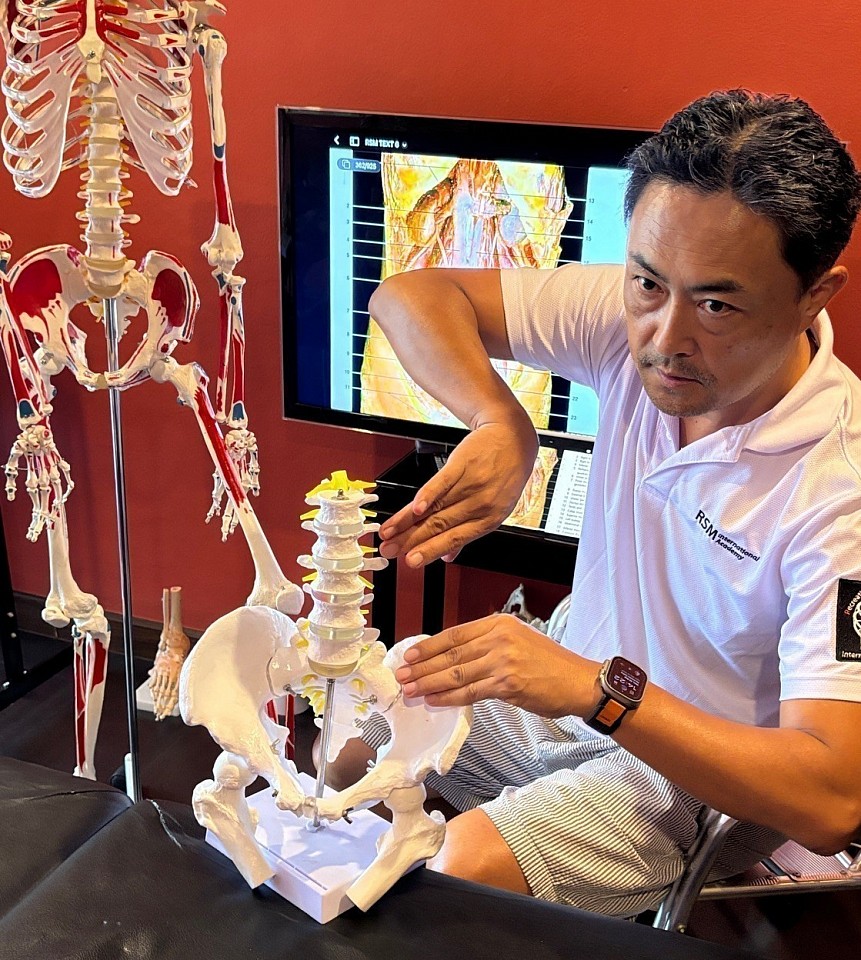
The course provided a deep introduction to orthopedic assessment skills that completely restructured how I view the spine. We didn't just memorize vertebrae; we analyzed movement patterns segment by segment using hundreds of clinical visuals. This wasn't just textbook theory; it was practical anatomy knowledge for orthopedic massage that finally explained why my clients’ lower backs weren't getting better with just pressure alone.
The Breath is the Key
The biggest "lightbulb moment" for me was the connection between breathing and the kinetic chain. I used to think breathing work was just for relaxation or yoga. Hironori Ikeda showed us how a restricted diaphragm or a locked rib cage can physically block hip mobility and shoulder rhythm.
We studied case studies in orthopedic massage therapy where the root cause of chronic lumbar pain was actually thoracic stiffness and poor breathing mechanics. Learning to assess and treat these patterns gave me a completely new way to tackle those "unsolvable" clients I’d been struggling with for months.
From "Guesswork" to Strategy
Before this training, my treatment plans were mostly intuitive. I would feel for knots and work them out. This course forced me to level up. It gave me the tools for developing treatment plans in orthopedic massage based on logic, not just feeling.
I learned how to integrate the palpation skills from Trigger Point therapy and the depth of Deep Tissue work into a cohesive orthopedic system. It felt like all the separate techniques I had learned over the last few years finally clicked together into a complete puzzle.
Safe Mobilization (LVLA)
As a massage therapist, I’ve always been cautious about joint mobilization. I don't want to be a chiropractor, and I don't want to hurt anyone. This course taught LVLA (Low Velocity Low Amplitude) mobilizations that are safe, effective, and perfectly legal for our scope of practice.
These orthopedic massage techniques blend seamlessly with myofascial release. They allow me to create space in a joint without any scary "cracking" or force. Understanding the role of fascia in orthopedic massage helped me realize that by releasing the soft tissue correctly, the joint often mobilizes itself. It’s a skill set that immediately separates you from the therapist down the street who just does "hard pressure."
Future-Proofing My Career
One of the most important takeaways came from a discussion on the industry's future. Clients can get stretches from YouTube apps now. To survive as a therapist, we need to offer something an app can't: precise assessment and manual correction.
Learning these assessment protocols used in orthopedic massage gave me a sense of job security I didn't have before. I’m no longer competing on price or ambiance; I’m competing on clinical results.
The Verdict
The class atmosphere was professional and intense, with real-time feedback that felt like a mini-residency. Whether you are a physiotherapist or a massage therapist like me, the level of instruction under Hironori Ikeda (MSc Sports Medicine) is world-class.
This advanced spine and breathing training was the turning point in my career. It gave me the confidence to handle complex cases and the skills to actually fix them. If you are ready to stop "rubbing" and start treating, this is the course you need.